
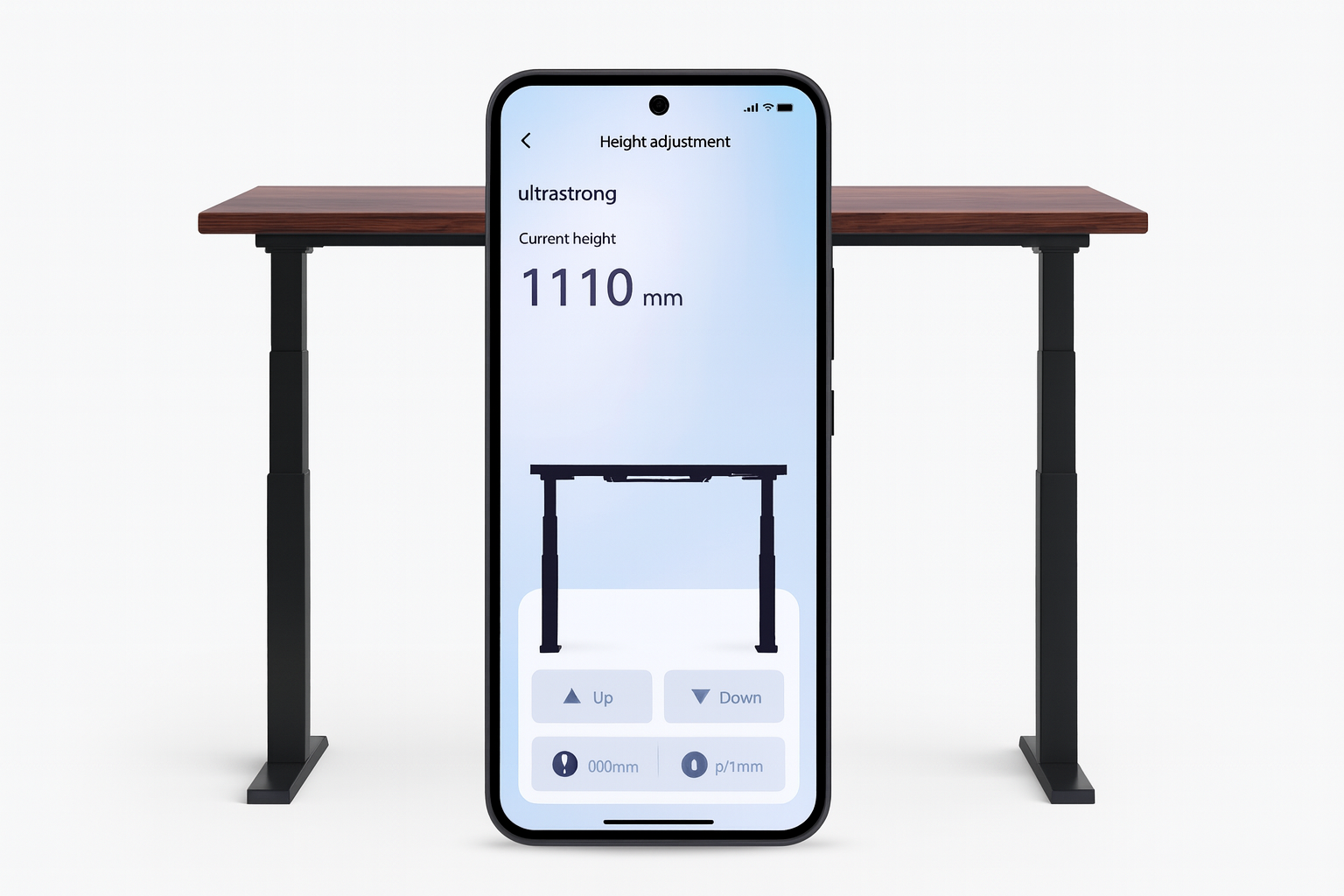
The idea of high-rise desks has been around for a long time, but modern technology has made them truly “smart” — smartphone control, analytics, and reminders are now in your pocket.
Why it's important to change your posture regularly
According to a study in the American Journal of Epidemiology , prolonged sitting (more than 6–8 hours a day) increases the risk of cardiovascular disease by 34%. Even regular exercise after work doesn’t fully offset the damage of a sedentary lifestyle.
Scientists at the Harvard School of Public Health confirm that alternating "sitting/standing" every 30–60 minutes significantly reduces fatigue, improves concentration, and improves the functioning of the cardiovascular system.
But there is a caveat: if changing posture is uncomfortable, most users stop doing it. That is why mechanical desks quickly lose their relevance: turning a handle every hour is a real barrier.
Even an electric remote, although faster, only solves the basic task of raising and lowering. It does not show how long you have actually sat or stood, does not help control the regime, and does not form a habit .
And this is where the Bluetooth adapter opens up a new level of use – via a mobile app:
- you see real statistics - how many minutes of sitting and standing you did during the day;
- you can automatically adjust altitude changes at a given time;
- set the sitting/standing mode with intervals;
- to get numbers that help understand the situation and discipline.
That is, the application is not just “another way to raise the table,” but a system that manages your work mode and makes changes real, not theoretical .
How to use a Bluetooth adapter
- Download the Flexispot Touch app (available for iOS and Android).
- Connect the adapter to the table — it plugs into a special port on the controller.
- In the app, select “Add device” → connect your table via Bluetooth.
- Configure:
¾ countertop thickness
¾ the required height (accurate to the millimeter),
¾ reminder intervals,
¾ working hours (weekdays/weekends).
- Use: track stats, get reminders, and change elevation at any time.
It's so simple that there's no point in stopping to change your position - the table will remind you and "force" you to stand up.
Why it really works
Many people buy a standing desk with great enthusiasm. The first few days you actually stand up, try different heights, and feel more productive. But as the week goes by, you find yourself increasingly finding yourself with the desk in the lower position. Sounds familiar?
This is not laziness in the classical sense. This is physiology. When we sit for a long time, the body enters a state of "energy conservation": muscles relax, blood circulation slows down, and the brain receives a signal to "stay still." Scientists from the Harvard School of Public Health confirm that the longer a person does not move, the faster a feeling of fatigue and apathy appears, even if you are not actually tired yet.
A study conducted in France (Bergouignan et al., 2016) showed that short breaks every 30 minutes significantly reduced feelings of fatigue and increased energy levels. And in a new 2025 study (Nature, Factors influencing reducing sedentary time in home office ), scientists directly named fatigue and low motivation as the main barriers to changing sedentary habits.
And this is where technology comes to the rescue. Because while the remote control allows you to simply raise the table, a mobile application with a Bluetooth adapter does more:
- reminds me that it's time to get up,
- shows statistics of sitting and standing,
- allows you to set an automatic schedule,
- and even gives numbers that motivate you to move.
This isn’t just “convenience.” It’s a way to combat our body’s natural inertia.
According to a study by Texas A&M University , workers who used a standing desk with an automatic reminder saw a 46% increase in productivity over 6 months, further evidence that technology motivates them to make the right choices every day.
to share:
Height-adjustable ophthalmology table: a new standard of comfort for the doctor and the patient
Where design comes to life: how TEHNOTABLE presented a new vision of the workspace at UDIW 2025