
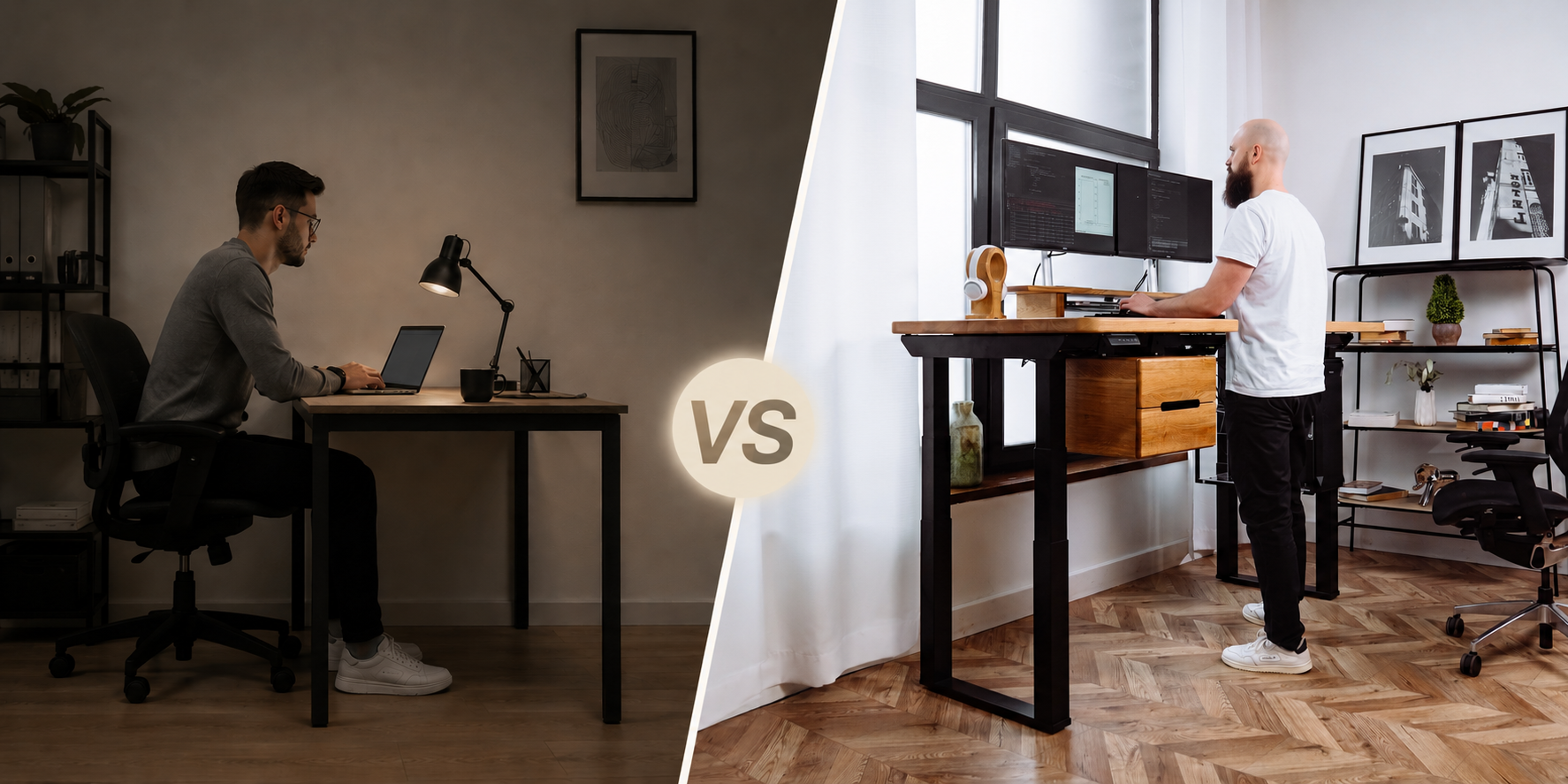
Choosing a desk usually seems like a simple everyday task — you need to set up a computer, organize your workspace, and resolve the issue for years. But this is precisely where the difference often lies between comfortable daily work and constant background tension that a person eventually stops noticing. And if you put emotions aside and look practically, it becomes clear: it's not so much about the furniture as it is about how your body will feel after 3–5 years of regular work.
A conventional desk: an understandable solution with a hidden cost
A fixed desk seems like the most logical option. It requires no adjustments, doesn't distract with mechanisms, and is perceived as "set it once and forget it." In the first days and even months, this is indeed the case: a person simply adjusts to the available height and works in their usual mode.
The problem appears later when it turns out that the body doesn't always adjust successfully. Shoulders begin to imperceptibly rise or move forward, the neck becomes fixed in a tense position, and the lower back experiences constant static load. And the most unpleasant thing about this scenario is its gradualness. There is no sharp discomfort, so there is usually no reason to change anything.
Over time, this manifests not as "pain" but in more common things: faster fatigue, a desire to change posture more often, a feeling of stiffness at the end of the day. And a person often perceives this as normal, although in reality, it is simply an adaptation to an uncomfortable sitting position.
Height-adjustable desk: a different logic of work
A height-adjustable desk changes the very principle of interaction with the workspace. It does not fix the body in one position but allows changing it throughout the day without pauses or reconfiguring the process. And this is its main difference, which is difficult to appreciate at the time of purchase but easy to feel with time of use.
Work ceases to be static. Some tasks are performed sitting, some standing, and this requires no extra effort or preparation. The body gets the opportunity to periodically relieve the same areas that work without interruption with a fixed posture.
It is important that this is not about a "fashionable alternative to sitting" but about reducing constant load. When the posture changes throughout the day, the muscles do not go into prolonged tension, and this directly affects well-being in the evening.
A difference that doesn't become apparent immediately
In the first few weeks, the difference between the two types of desks may seem minimal. And this is logical: the body does not change habits instantly. But then the cumulative effect begins to work.
With a fixed desk, the load is repeated the same way every day. With an adjustable one, it is distributed and changed. As a result, after a few months, the difference becomes noticeable: less "stiffness" in the back, less fatigue after long work sessions, a more even state throughout the day.
And here it is important to understand: this is not about instant comfort, but about the absence of accumulated discomfort.
Financial logic: not just about the purchase price
If you only look at the cost, a conventional desk almost always wins. It's cheaper and simpler. But a long-term assessment is a bit more complex.
The workspace affects how a person feels every day. And discomfort rarely remains just discomfort — it almost always leads to additional expenses or compensatory solutions: pillows, stands, massages, attempts to "correct" posture after the problem has already formed.
A height-adjustable desk, in this sense, acts as a preventative measure. It doesn't eliminate all possible problems but reduces the likelihood that they will appear due to constant static load.
Productivity as a side effect of comfort
There's another point that is often underestimated — the impact on work rhythm. When the body is constantly in a less-than-comfortable position, some attention inevitably shifts to discomfort. A person is more easily distracted, changes posture more often, and loses concentration faster.
When there's an opportunity to change position without stopping work, the load is distributed more smoothly. This doesn't make a person "automatically more productive," but it removes unnecessary factors that accumulate throughout the day.
The difference between a conventional desk and a height-adjustable desk manifests not at the time of purchase, but in the process of daily work. One option fixes the conditions, the other allows them to be adapted to the person.
And if you look at the long term, the question is no longer which desk is cheaper or simpler. The question is rather with which of them the workday will remain comfortable not only at the start, but also after years of regular load.
to share:
Wooden Countertop: What You Need to Know Before Buying — Properties, Care, Warranty
How to choose a height-adjustable desk for the office: what to look for before buying