
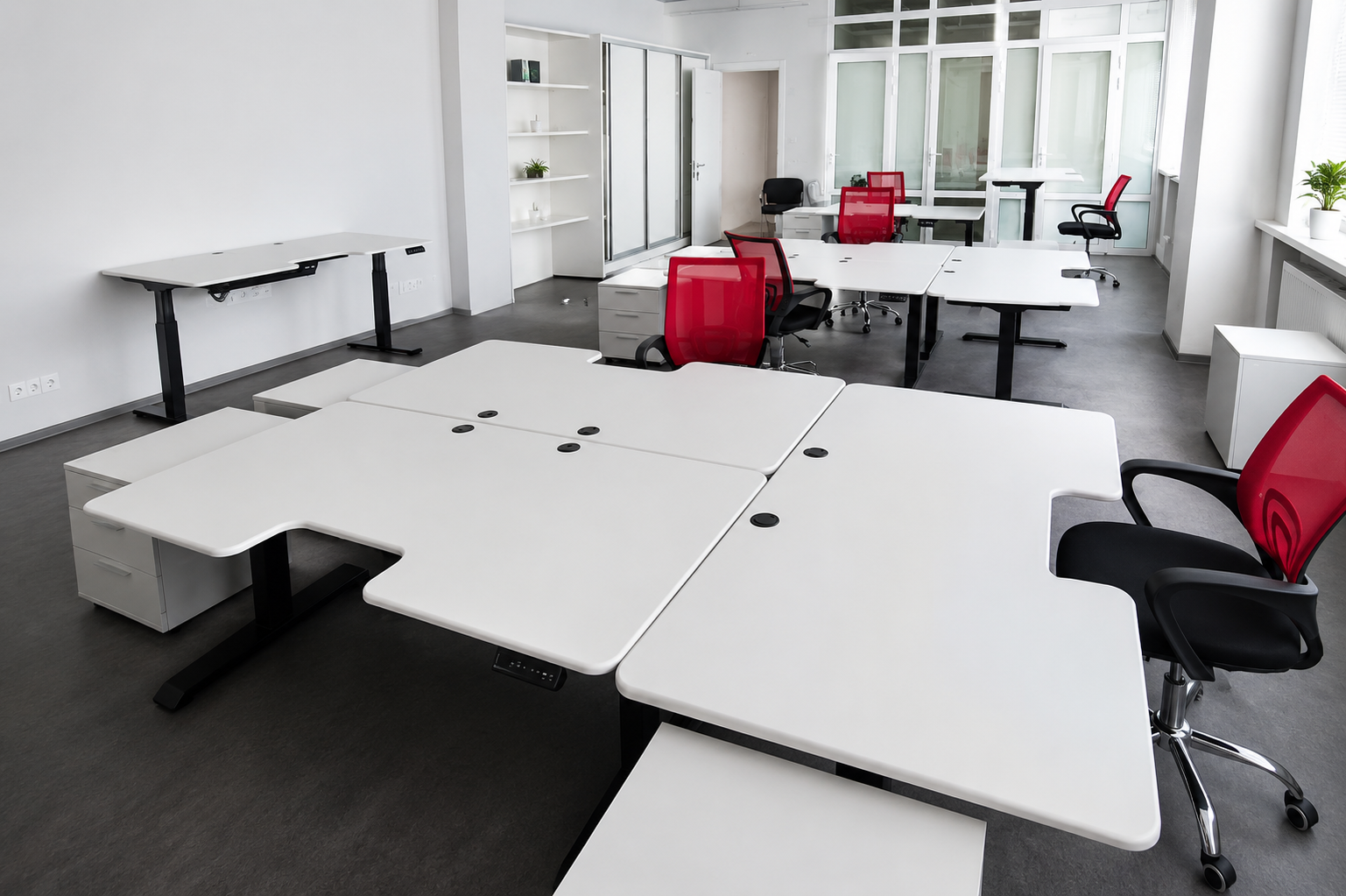
Choosing a height-adjustable desk for an office is usually not an impulse buy. It's a decision that needs to work every day, without glitches or unnecessary questions. And this is where many people make mistakes: they look at the appearance or individual characteristics but miss the main point—how the desk will perform under real office load, when it's used not by one person occasionally, but constantly.
For a desk to truly become a convenient work tool, it's important to evaluate it not as furniture, but as part of a work system.
Load and Stability: The Foundation Often Underestimated
The first thing to pay attention to is the stability of the structure and the permissible load capacity. In an office, a desk is rarely used in a "gentle mode." It holds a monitor or several screens, a laptop, documents, and sometimes additional equipment. And all of this must remain stable even when the height is changed.
If the desk starts to "wobble" or lose rigidity in the raised position, it quickly becomes a constant irritant. In long-term work, such minor issues are felt much more intensely than they seem during purchase.
Adjustment Range: Not a Formality, But a Practical Parameter
Often, the height range is perceived as a technical figure that is overlooked. But it is precisely this range that determines how well the desk will suit different people.
In an office, employees of different heights may work at the same desk, and if the range is too narrow, some users simply won't be able to adjust to a comfortable position. As a result, the desk loses its primary function—adaptation to the person.
A good model should allow for comfortable sitting work and a full standing mode without compromising posture.
Speed and Smoothness of Adjustment: A Matter of Work Rhythm
In an office environment, not only the ability to change height is important, but also how quickly it happens. If the process takes too long or is accompanied by jerks, people simply stop using it.
Smooth raising and lowering is not about "convenience for convenience's sake." It's about whether a person will change their position at all throughout the day. The simpler the process, the more often it is used, and the more beneficial the desk becomes.
Noise Level: A Detail That Becomes Noticeable Every Day
In open-plan offices, noise is a separate comfort factor. And a height-adjustable desk also plays a role here. A loud motor or sharp sounds during position changes quickly begin to bother not only the user but also those around them.
Quiet operation of the mechanism is something that initially seems secondary, but in reality, directly affects the atmosphere in the workspace.
Control and Memory Settings: Time Savings in the Long Run
In an office, the desk is not always used by the same person, and even with individual use, it is important that the settings do not turn into daily manual calibration.
Height memory functions allow you to save several positions—sitting and standing—and switch between them with a single press. This is a small detail that saves time throughout the day and reduces the "entry barrier" to using the adjustment function.
Reliability and Lifespan: An Office Is Not About "Careful Use"
An office desk operates differently than a home desk. It goes through dozens of lifting and lowering cycles, sometimes non-stop throughout the day. Therefore, not only external appearance or basic functionality is important, but also the lifespan of the mechanism.
A high-quality drive and a sturdy frame directly impact the service life and the absence of future problems. And here, it's better to choose with a margin right away than to face unstable operation later.
That is why for offices, models that combine a wide range of height adjustment and sufficient load capacity are most often chosen. For example, one of the most popular solutions in TEHNOTABLE corporate projects is the BESTFIT PRO dual-motor height-adjustable desk with an MDF tabletop. The adjustment range of 60–125 cm allows comfortable setup of the workplace for most users regardless of height, and a load capacity of 125 kg ensures stable operation even with multiple monitors, a system unit, brackets, and other office equipment.
Choosing a height-adjustable desk for an office is not about individual functions, but about the stability of the system as a whole. A good desk should not draw attention to itself during work. It should simply perform its function: smoothly change height, withstand loads, and not interfere with the workflow.
And if you look at it practically, the best option is the one that doesn't require unnecessary decisions every day. A desk either becomes part of the work rhythm, or it remains just furniture that is rarely revisited.
to share:
Standard desk vs. height-adjustable desk: which is truly more cost-effective in the long run
Electric vs. Manual Height-Adjustable Desks: What Truly Matters in Daily Use