
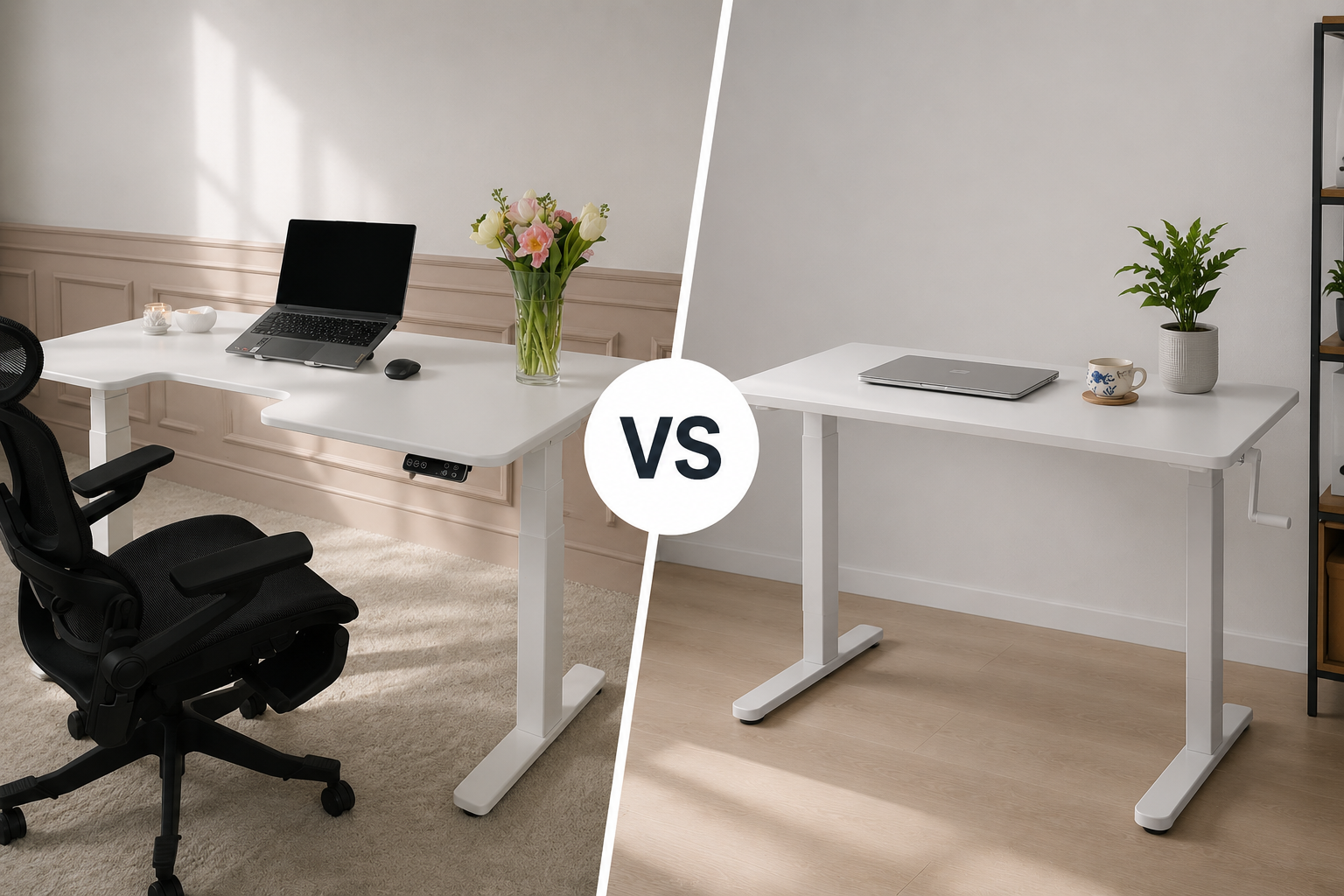
When it comes to height-adjustable desks, the conversation usually quickly shifts to features: motors, lift speed, load capacity, memory levels. But in real life, people think about other things – how easy it is to change positions throughout the day and whether they will actually do it at all. Because even the most technologically advanced system makes no sense if it is inconvenient to use in a normal work rhythm.
That is why electric and mechanical desks should be compared not by their "passport data", but by how they behave in everyday work, when the day is already in full swing, tasks follow one after another, and there is no desire to turn desk adjustment into a separate event.
Mechanical desk: a working solution without unnecessary complexity
A mechanical desk is often perceived as a more "reliable" option – and there is logic in this. A simple design, minimum electronics, no dependence on an outlet. It does not require maintenance in the usual sense and usually serves stably for a long time.
But there is a nuance that becomes noticeable only in the process of use. Adjusting the height here is an action that requires effort and time. And if you need to change positions rarely, it's not a problem. But in real work, where you want to alternate sitting and standing several times a day, any additional effort begins to play a role.
As a result, the desk remains more fixed with the possibility of adjustment, rather than a truly "dynamic" working tool. And this is normal if the person initially does not plan to change positions often.
Electric desk: when convenience becomes a habit
An electric desk works differently – and this is its meaning. There is no need to twist or lift anything manually. Everything comes down to pressing a button, and changing the height takes a matter of seconds.
In practice, this changes behavior. People start changing positions more often not because "they have to", but because it requires no effort. Tired of sitting – raised the desk. Need to focus while sitting – lowered it back. Without pauses, without preparation, without the feeling that you are distracted from work.
And it is this simplicity that makes an electric desk not just more technological, but more "alive" in everyday use.
The difference that manifests itself not in characteristics, but in the rhythm of the day
To be honest, the key difference between these two options is not in the mechanism, but in the frequency of using the adjustment.
A mechanical desk requires a decision: "now I will change the height." An electric one requires nothing but desire. And in this lies the difference, which is difficult to assess in advance, but easy to feel after a few weeks of work.
Gradually a habit forms: if something is uncomfortable, it is easy to fix. And then changing position ceases to be a rare adjustment and becomes a natural part of the working day.
Reliability vs. convenience: what the choice actually looks like
Mechanical desks are more often chosen for their sense of stability. They have fewer elements that can break down, and this creates a feeling of a "calm" solution. Especially if the desk is installed once and does not involve active changes in modes.
Electric models, on the contrary, focus on comfort. But this comfort comes at a price, not only in money but also in dependence on electronics. Although in practice, modern mechanisms are quite reliable, and this is no longer "fragile equipment" as is commonly thought.
Essentially, the choice here is not about reliability in absolute terms, but about what is more important in daily work: simplicity or ease of use.
Where an electric desk is truly justified
There are scenarios in which an electric desk fully reveals its advantages – primarily, daily computer work, when a person spends most of the day at the workplace.
In such conditions, the ability to quickly change the height of the tabletop ceases to be an additional function and becomes a practical way to reduce the load on the back, neck, and legs. The more often the "sitting-standing" position changes during the day, the more benefits the electric drive provides.
At TEHNOTABLE, we help you choose an electric desk taking into account the user's height, work specifics, number of monitors, and equipment weight. For some, a compact 2-leg model is sufficient, while for trading stations, engineering projects, studios, or control centers, 4- or even 6-leg structures may be needed. That is why, before choosing, it is important to consider not only the size of the tabletop but also the real tasks that will be performed at the desk every day.
When mechanics are more than enough
If the work at the desk is irregular or the height is rarely changed, a mechanical option looks quite rational. It is simpler, cheaper, and does not require attention.
And in such cases, overpaying for an electric drive may indeed not provide significant benefits – simply because the adjustment function is rarely used.
The difference between an electric and a mechanical desk is not about "which is better," but about how exactly it will be used daily.
Mechanics are about simplicity and rare adjustments. Electricity is about making height changes a natural movement, not a separate task.
And in the long run, the winner is not the option that looks more technological, but the one that a person will actually use regularly.
to share:
How to choose a height-adjustable desk for the office: what to look for before buying
How to Properly Adjust Desk Height: Ergonomics for Home and Office