
The profession of a nail technician combines high precision of movements, concentration, and prolonged work in a static posture. In a typical workday, a technician spends several hours at a table, performing procedures that require stable hand positioning and minimal movement error.
It is the nature of the load that defines the key requirements for workstation organization.
Static Load and its Physiological Consequences
Unlike dynamic activity, static work involves maintaining the body in one posture for an extended period. Biomechanically, this creates constant muscle tension and compressive load on the musculoskeletal system.
Ergonomic studies show that prolonged static posture can be accompanied by:
-
increased tension in the neck and shoulder muscles
-
increased load on intervertebral discs
-
impaired local blood circulation
-
accelerated muscle fatigue
According to the European Agency for Safety and Health at Work, over 60% of workers whose activities involve static postures regularly experience musculoskeletal discomfort, including back and neck pain.
Head Position and Neck Strain
During work, a nail technician often works with their head tilted forward. From a biomechanical perspective, even a slight tilt significantly alters the load distribution.
Studies of the cervical spine demonstrate:
-
a 15° forward head tilt almost doubles the load
-
at a 30° tilt, the load can reach 18–20 kg
This is one of the key factors in the development of chronic neck and shoulder muscle tension.
Fixed Table Height as a Source of Excessive Load
Most standard manicure tables have a fixed height. In such a configuration, the technician is forced to adapt their body position instead of adapting the work surface.
Typical consequences:
-
incorrect elbow angle
-
stabilized shoulder position
-
forward leaning torso
-
increased static tension
According to ergonomic principles, the optimal height of the work surface is determined by the elbow level at an angle of about 90°. Even deviations within a few centimeters already create an additional load.
Height-Adjustable Table as an Ergonomic Adaptation Tool
A height-adjustable table allows the work surface to be matched to the technician's anthropometry and work scenario.
Practical advantages:
-
maintaining a neutral spine position
-
reduced shoulder girdle tension
-
optimized hand position
-
possibility of varying the load
Cornell University Ergonomics studies show that regular changes in working posture can reduce muscle discomfort by 30–40%.
Variability of Posture: Sitting and Standing
Standing work is not a substitute for sitting but is considered a mechanism for redistributing the load. Alternating postures improves blood circulation and reduces static fatigue.
The recommended interval for changing postures in ergonomic practices is 40–45 minutes.
Structural Stability as a Factor in Work Precision
Manicure procedures require high precision of movements. Any micro-vibrations or instability of the work surface directly affect movement control and the level of hand tension.
A rigid stable construction ensures:
-
absence of play
-
stability at any height
-
predictable behavior of the work surface
Tabletop Material and Operating Conditions
The work surface in nail service regularly comes into contact with liquids, antiseptics, and is subjected to frequent cleaning.
MDF is widely used in professional environments due to:
-
higher moisture resistance compared to particleboard
-
better geometric stability
-
higher wear resistance
Ergonomics as an Element of Professional Standard
Physical discomfort directly affects concentration, productivity, and work quality. An ergonomically organized workstation is not an element of comfort, but a tool for maintaining stable efficiency throughout the workday.
Practical Experience
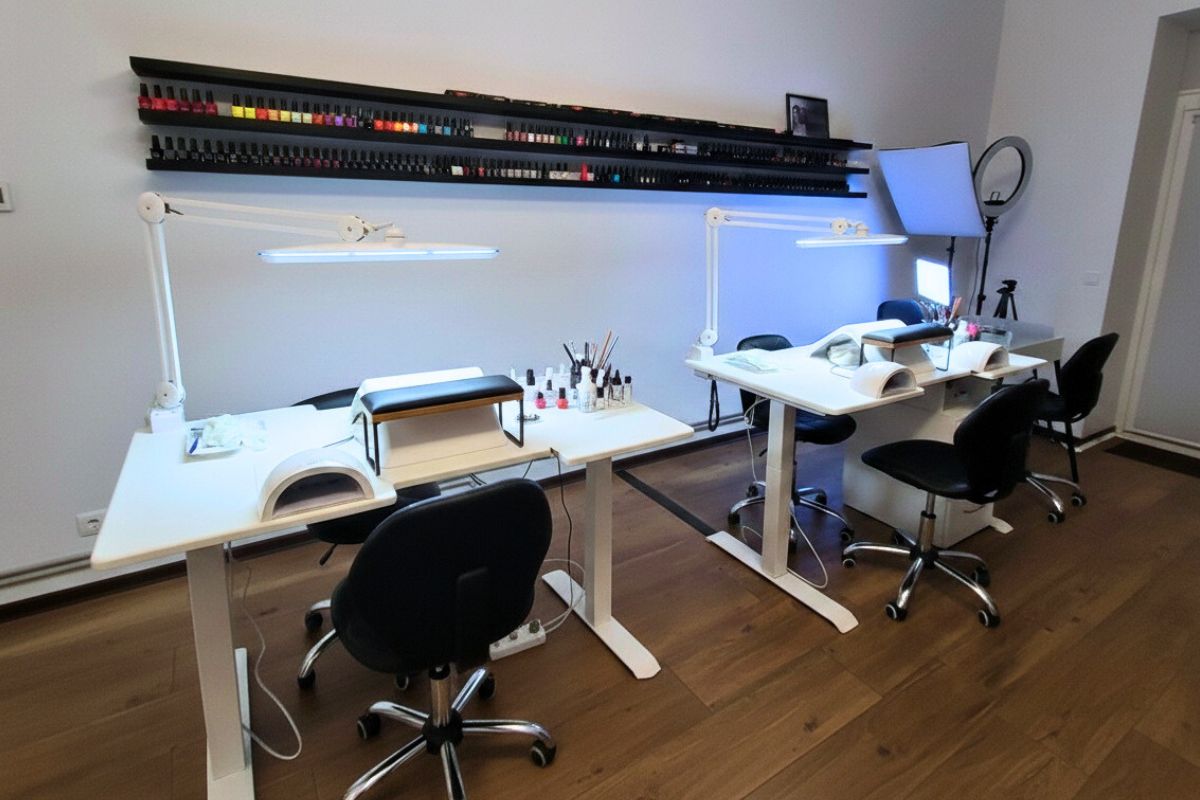
Height-adjustable tables are already in use in one of the nail salons in Kyiv. The practicality of the solution and the features of working in a real environment can be assessed in the video review by the technician.
You can watch the video below:
to share:
Top 7 mistakes when choosing a desk for working at a PC: professional advice from ergonomists
Varicose Veins: A Problem of Sitting, Standing, or Inactivity? Phlebologist's Answer