
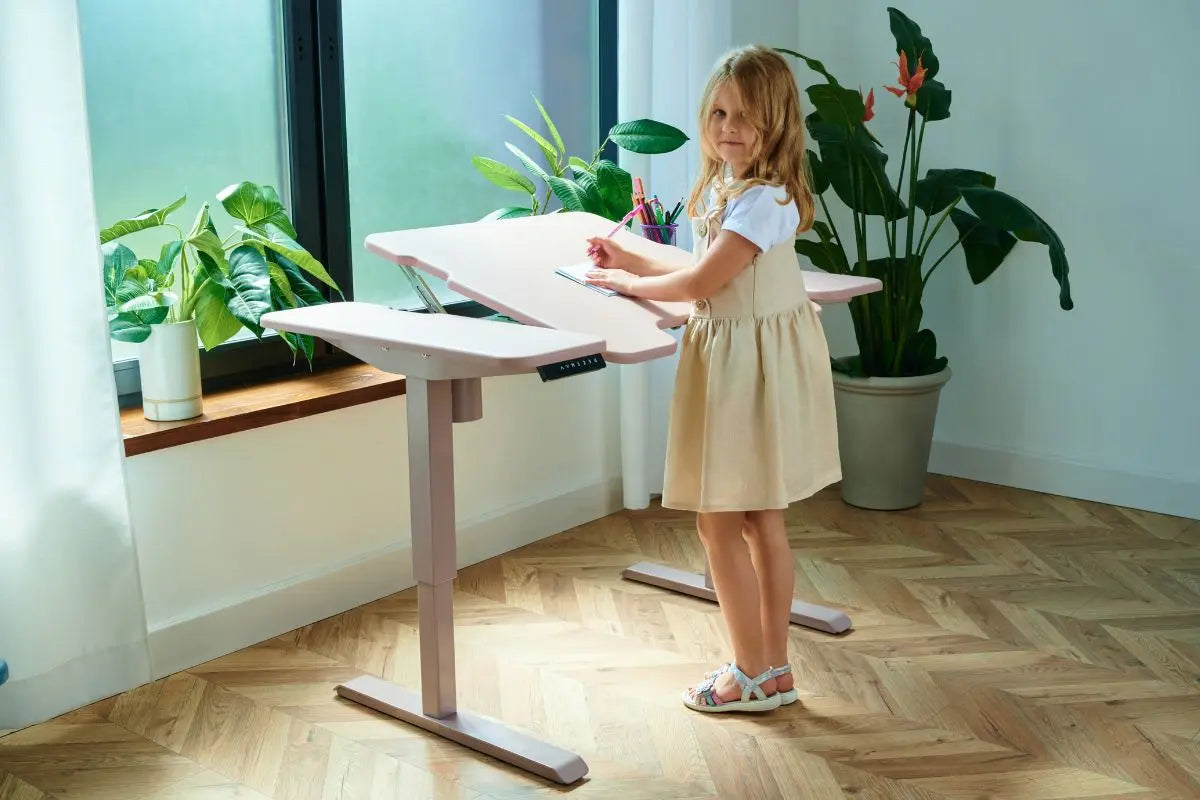
The most common mistake when setting up a children's corner at home is to use a school desk as a model. The logic is understandable: if that's how it is at school, then that's how it should be.
In reality, it is quite the opposite. School furniture is the worst possible benchmark, and this is not a value judgment, but what researchers have been methodically measuring for about twenty years.
Why a school desk is a poor model
Ergonomists use the concept of "mismatch": the discrepancy between a student's body dimensions and the dimensions of the furniture they sit at. This is measured simply — by taking the child's anthropometric measurements, measuring the desk, and comparing them.
The results are consistently disappointing. In a Spanish study of 132 middle school students, the mismatch was 98.5% for chairs and 100% for desks — meaning not a single desk in the classroom fit any student according to calculated parameters. In a Saudi study of nearly 900 students, the desk height was found to be incorrect for 94.1% of middle school children.
A recent 2024 Slovenian study (Loredan, Lipovac, Kastelic, Šarabon, PLOS ONE) went further and linked furniture mismatch to pain complaints. In a sample of 238 schoolchildren and students, the neck, lower back, shoulders, and upper back were the most frequently affected areas, and the prevalence of lower back pain increased with age.
The reason is simple: desks are produced in a few standard sizes, while children in the same class differ in height by 15–20 centimeters. Someone will inevitably end up at a desk that is too big or too small — and will sit there for six hours every day.
Therefore, the task at home is not to "replicate school," but to compensate for it.
How to measure the correct height: forget the charts
There are many "height vs. desk height" charts on the internet. The problem is that they are averaged and are often wrong for a specific child: people have different body proportions, and the length of the shin and torso can differ significantly at the same height.
An example from our practice: according to most charts, a person who is 177 cm tall needs a 75–76 cm desk. In practice, the comfortable seating height for such a person often turns out to be 69–70 cm — meaning a standard office desk is 5–6 centimeters too high for them. That same 5 centimeters that forces them to hunch their shoulders.
Therefore, you should not measure according to a chart, but according to the child. The method takes a minute.
Step 1. Chair. Seat the child so that their feet are flat on the floor and the angle at the knees is about 90 degrees. The thigh is parallel to the floor, and the edge of the seat does not press under the knee — there remains a gap of 3–4 centimeters. This is the correct seat height. If the chair does not go low enough, you need a footrest; otherwise, everything that follows makes no sense.
Step 2. Desk. The child sits straight, shoulders relaxed and lowered, arms bent at the elbows at an angle of about 90 degrees. The height at which the forearms are currently resting is the height of the tabletop. Simply measure from the floor.
Step 3. Check. Place your forearms on the tabletop. The shoulders should not rise even a centimeter. If they did, the desk is too high. If the child is reaching upward or leaning forward, it is too low.
That's all. Two numbers obtained in a minute are more accurate than any chart.
The second question is what to do with these numbers later. A child grows 5–7 centimeters per year, and sometimes even more during growth spurts. This means that a desk perfectly measured in September will no longer be right by spring. Either change the furniture every 2–3 years, or get a height-adjustable desk right away, with a range that covers the entire school period.
The logic of "we'll buy an adult one, they'll grow into it" is a decision to pay with posture for saving on furniture.
Why a tiltable tabletop is needed
Old school desks were tilted. They became flat not because it was better, but because it was cheaper and easier to stack them.
The mechanics here are as follows: when a child writes or reads on a horizontal surface, the notebook lies at an angle of almost 90 degrees to the line of sight. To see the line, they have to lean their head forward. The head weighs 4–5 kilograms, and every degree of tilt increases the torque on the cervical spine. After forty minutes of such geometry, what the child calls "I'm tired" appears.
A tilt returns the work surface closer to a perpendicular angle to the line of sight. The head remains over the shoulders, and the neck does not stretch forward.
Practical benchmarks:
- reading — tilt of about 20–30 degrees
- writing — about 10–15 degrees, a larger tilt is uncomfortable for the hand
- screen work — horizontal, no tilt needed here
Therefore, the ideal option is a surface that changes tilt rather than a fixed one. A desk with adjustable height and tabletop tilt covers both scenarios: raise the tilt for lessons with a textbook, lower it to the horizontal position for a laptop.
If the desk is already bought and flat, a book stand is a savior. It is worse than tilting the entire surface, but significantly better than nothing.
What chair a child needs at different ages
A properly organized children's workspace is always a combination of a desk and a chair. The desk must match the child's height and allow them to work without raised shoulders or excessive torso leaning, while the chair must provide stable support for the pelvis, back, and legs.
That is why a chair should be selected not separately from the desk, but as part of a unified ergonomic system.
6–9 years
At this age, the most important thing is the correct seating geometry.
Feet must have stable support: on the floor or on a footrest. If the legs dangle, the child quickly starts to slide forward, tuck their legs under themselves, or look for support on the desk's crossbars.
Seat depth is just as important. The child should be able to lean their back against the chair's backrest, while the edge of the seat should not press on the area under the knees.
In early primary school age, chairs with simple and intuitive adjustments that can be quickly adapted to the child's height work especially well.
10–13 years
During the period of active growth, it is important that both the desk and the chair can change along with the child.
At this stage, correct lumbar support positioning, the ability to adjust the height of the backrest, and seat depth already matter.
The goal of ergonomics here is not to "fix the back straight," but to ensure the child can work without constant muscle tension: not reaching forward, not lifting shoulders, and not sitting on the very edge of the seat.
14+
In adolescence, anthropometry often approaches that of an adult, so you can consider full-fledged ergonomic chairs.
It is desirable that they have seat height and depth adjustment, lumbar support, adjustable armrests, and allow the user to get close to the tabletop.
At the same time, you should focus not only on age, but primarily on the height and body proportions of the specific child.
Why a standard adult office chair often does not suit a younger child
The problem is not in the "adult" chair itself, but in its geometry. For many models, the minimum seat height and depth are designed for an adult.
Because of this, the child either cannot reach the floor with their feet or cannot lean on the backrest and position their legs correctly at the same time.
For younger schoolchildren, it is therefore more appropriate to choose orthopedic and ergonomic chairs for children, in which adjustment ranges are calculated specifically for children's proportions and can adapt as they grow.
Good posture emerges when the desk and chair work together: feet have support, the pelvis is stable, the back is supported, elbows are positioned comfortably relative to the tabletop, and the child does not need to adjust their body to the furniture.
Why changing position is more important than "proper posture"
This is the main thing that is usually overlooked.
Proper posture does not exist as something one can maintain for hours. Any static posture, even if perfect in all angles, starts to become tiring after 20–30 minutes: some muscles work without a break, others turn off, and blood circulation in the legs slows down.
In 2020, the WHO released separate recommendations on reducing sedentary behavior in children and adolescents, recognizing it as a risk factor for physical fitness, cardiometabolic health, behavior, and sleep. European adolescents spend more than seven hours a day sitting, with 63 to 80% of the time in school being sedentary.
Therefore, the main parameter of a workspace is not "how correct the posture is," but "how easy it is to change it." A desk at which one can work while standing gives the child the opportunity to do just that: read or recite a poem while standing, then sit down to write.
As for the psychological component, it is worth being precise. Research shows primarily an impact on attention and restlessness, not on mood in general. An interesting result came from a study published in PLOS ONE: teachers often fear that standing desks excite children and make the classroom unmanageable. The authors measured saliva cortisol levels after 45 minutes of standing work and found no increase in stress compared to sitting work. So, the concern was not confirmed.
Schools that removed chairs
The most well-known example is the Vallecito Elementary School in San Rafael, California. In 2015, it became the first school where every student received a standing desk: parents raised $110,000, and 19 out of 22 classrooms were completely refitted. A key detail is that the desks were equipped with a "fidget bar," a crossbar at the bottom on which one can place a foot and swing the other. Stools were left in the classrooms: one could sit down at any time, but teachers reported that the children almost never sat. After a few months, the administration reported better concentration and less restlessness.
An Australian study that tracked a fourth-grade class over a full school year yielded measurable figures: when children worked at a standing desk, standing time increased by 17–26 minutes a day, and sitting time decreased by 17–40 minutes.
But it would be honest to mention another result. A 2025 Belgian study in middle schools showed a mixed picture: some students noted better concentration, while others complained of fatigue, discomfort in the legs, and, conversely, worse focus. The authors' conclusion is practical and useful for parents: one should start with short 2–5 minute intervals, gradually increase them, change positions regularly, and explain to the child how to stand correctly.
In other words, it is not "standing instead of sitting" that works, but alternating. This is the reason why an adjustable desk for a child makes sense, while a stationary stand — not always.
Screen and light
Screen height. The top edge of the monitor is approximately at eye level. A laptop always violates this rule: if the keyboard is at the correct height, the screen is too low. This is corrected by a laptop stand plus a separate keyboard or a monitor arm for a stationary monitor.
Distance to the screen — approximately an arm's length.
Light comes from the side opposite the working hand. For a right-handed person — from the left. Otherwise, the hand casts a shadow on the notebook, and the child instinctively leans over.
A desk lamp is needed even during the day. The contrast between a bright screen and a dark room tires the eyes faster than the work itself. For lessons, neutral light of 4000–5000 K is more comfortable. If there is little space on the desk, a screenbar lamp attaches to the monitor and does not occupy the tabletop.
Window — to the side. Facing the window causes glare in the eyes, with your back to the window — reflections on the screen.
Checklist
- Chair height measured by the angle at the knees, not by a chart
- Feet have support: floor or footrest
- Desk height measured by the elbows with lowered shoulders
- Adjustment range covers the next 3–4 years
- Possibility to tilt the surface for writing and reading
- Tabletop depth from 60 cm, for a monitor from 24″ — from 70 cm
- Chair selected by age, not "to grow into"
- Top edge of the screen at eye level
- Light from the side opposite the working hand, plus a desk lamp
- The child can change body position without standing up from the desk
Frequently asked questions
Can you rely on "height vs. desk height" charts? As a rough benchmark — yes, as a final decision — no. Body proportions differ at the same height, and a 4–6 centimeter error happens regularly. It is more reliable to measure by the angles in the knees and elbows.
At what age does a child need a height-adjustable desk? From the first grade, when systematic work at a desk begins. It is in primary school that the gap between the child's height and standard furniture is the largest.
How much time can a child stand at a desk? One should start with 5–10 minutes and gradually increase. Research shows that a sharp transition to prolonged standing has the opposite effect: leg fatigue and worse concentration. The goal is alternating, not standing for the entire lesson.
Can you seat a first-grader at an adult desk? Temporarily — with a footrest and a high chair. But a height of 75 cm for a 120 cm tall child will remain too much: the elbows will be above the norm, the shoulders will rise.
How to understand that the desk has become too small? The child spreads their elbows to the sides, moves away from the desk, or is constantly leaning toward the notebook. The angle at the elbows stops being correct the fastest — check that specifically.
Is a footrest necessary? Yes, if the feet do not touch the floor completely. When legs dangle, weight shifts to the tailbone and lower back, and no chair will compensate for that.
Won't the child be distracted while working standing up? The concern is common, but research on the stress response does not confirm it. The practice of schools that switched to standing desks shows the opposite: restlessness decreases because energy is spent on movement, not on fidgeting in a chair.
to share:
How to Set Up an Ergonomic Home Workspace: Furniture, Lighting, and Proper Posture
Стіл з регулюванням висоти під час відключень світла: практична інструкція TEHNOTABLE